Client:
DownTown JV
DownTown JV link opens in a new tab
Project Owner:
Auckland council
Auckland council link opens in a new tab

NOVIA machine learning noise classification with 96% accuracy, enabling targeted compliance management during seismic strengthening of Auckland’s seawall.
about Quay street strengthening
To protect Quay Street, seismic strengthening of the 100-year-old seawall is needed that will secure the area for the next 100 years. Without the Seawall, significant parts of downtown Auckland would be under water.
The strengthening process employs three different methodologies:
■ Palisade wall – A series of piles are inserted into predrilled holes and socketed into the bedrock to form an in-ground wall.
■ Jet grouting – Grout is pumped into pre drilled holes to form columns from bottom to top.
■ Anchoring existing seawall – A series of incline anchors are drilled through the seawall into the bedrock.
Environmental considerations
Quay Street construction site has noise limits set at low levels, especially when night time works are required. Set limits are of the same order of magnitude than the background noise levels, therefore exceedances can originate from non-construction activities such as police sirens, motorbikes, buses and create “false alarms”. So how, to make the difference between noise related to site work versus normal city traffic?
NOVIA solution
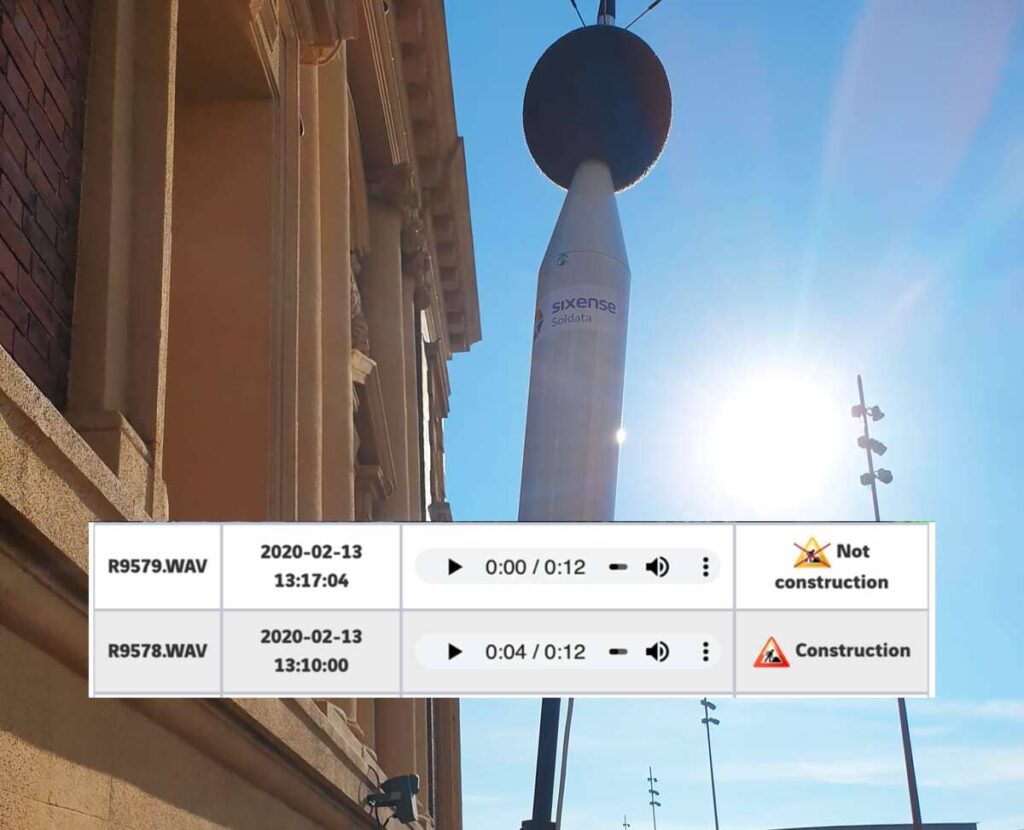
Solution to this is NOVIA, machine learning sound recognition algorithm for noise management developed by SIXENSE. With an accuracy greater than 96% the solution classifies the likely source of the alarm when triggered. Noise alerts and reporting are carried out automatically. Site supervisors have instantaneous access to classified events displayed on GEOSCOPE and can listen to event recordings for verification if needed.
SIXENSE approach allows to focus only on construction-related alerts, in real time, and manage complaints with an evidenced-based dialogue.
Images of the project

Noise monitors
Vibration monitors
NOVIA machine learning
GEOSCOPE platform.
alarms processed
classification accuracy